
Deaf Mental Health Matter: History, Access and Healing

Deaf Mental Health Matters: History, Access, and Healing
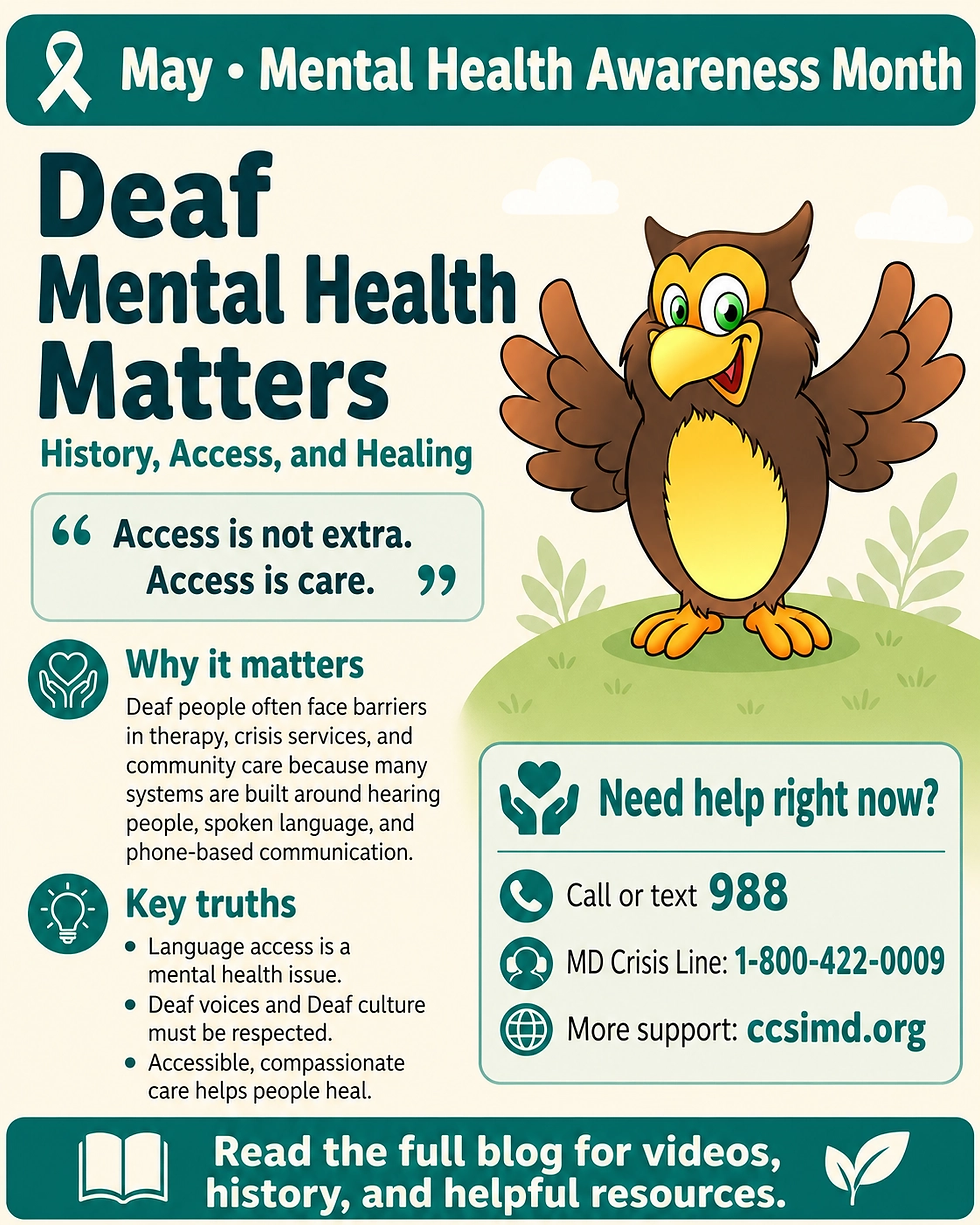
May is Mental Health Awareness Month, a time to raise awareness, reduce stigma, and remind people that mental health is part of everyone’s life. It is also a time to ask an important question:
Who still does not have equal access to mental health care?
For the Deaf community, mental health awareness must include language access, Deaf culture, communication rights, and the painful history of being misunderstood. Deaf people have often faced barriers in therapy, hospitals, schools, crisis services, and community programs because many systems were built around hearing people, spoken language, and phone-based communication.
This blog is not only about awareness. It is about dignity, access, and making sure Deaf people are truly heard.
As a Deaf person and advocate, I believe mental health awareness must include Deaf voices. Too often, Deaf people are expected to adjust to systems that were not built for us. But true inclusion means changing the system so Deaf people can receive support with dignity, language access, and respect.
Deaf mental health matters — not as a special issue, but as a human rights issue.
OUL Blog Series: Mental Health Matters
OUL will be writing a variety of blogs about Mental Health Matters, with a special focus on the experiences of Deaf and Hard of Hearing people, including those who are neurodivergent.
Through this blog series, OUL hopes to raise awareness, reduce stigma, and encourage honest conversations about mental health, accessibility, language access, Deaf culture, learning differences, neurodivergence, identity, and inclusion.
Many Deaf, Hard of Hearing, and neurodivergent people face barriers that are often misunderstood or overlooked. These barriers can affect communication, education, employment, relationships, self-esteem, and access to mental health support.
Our goal is to help people better understand these experiences and to remind our community that everyone deserves care that is respectful, accessible, compassionate, and inclusive.
Mental health matters. Deaf voices matter. Hard of Hearing voices matter. Neurodivergent voices matter. Access matters.
Access Is Not Extra. Access Is Care.
Deaf people deserve mental health support in their own language, with dignity, respect, and full communication access.
Mental health care depends on communication. A person needs to be able to explain feelings, trauma, anxiety, depression, grief, fear, confusion, or crisis clearly and directly.
For Deaf people, this means mental health services must provide real communication access. Without access, people may feel isolated, frustrated, unsafe, or invisible. With access, people can feel seen, understood, and respected.
A Short History of Mental Health
Mental health has never had one simple explanation. Across history, people have tried to understand mental illness through religion, superstition, medicine, psychology, therapy, and science.
In earlier times, people often explained mental illness through spiritual ideas, fear, or misunderstanding. Later, society moved toward hospitals, medical treatment, talk therapy, medication, and brain-based research. These changes helped many people, but they also caused harm when people were judged, mislabeled, or treated without dignity.
The history of mental health teaches us something important: progress is not only about new treatments. It is also about compassion, respect, and listening to people’s lived experiences.
Mental health care should never be only about controlling symptoms. It should also be about understanding the whole person — their language, culture, history, identity, trauma, family, community, and daily life.
Deaf People and Mental Health History
For Deaf people, mental health history is especially complicated.
Too often, Deaf people were misunderstood by hearing professionals who did not know sign language or understand Deaf culture. Some Deaf people were misdiagnosed because their communication style, facial expressions, body language, or signing were misunderstood. Others experienced isolation because they were denied full access to language and communication.
In the past, many Deaf children were pushed toward oralism, where speech and lipreading were valued while sign language was discouraged or banned. This caused deep harm for many Deaf people. When a Deaf child does not have full access to language, it can affect learning, emotional development, identity, relationships, and mental health.
This is why language access is not just an education issue.
It is also a mental health issue.
Deaf people need mental health services that are both culturally respectful and linguistically accessible. That means services must respect ASL, Deaf culture, Deaf identity, and direct communication whenever possible.
Language Access Is Mental Health Access
Mental health care depends on trust, safety, and communication.
A Deaf person should not have to struggle to explain private feelings through barriers. A Deaf person should not have to depend on family members to interpret trauma, depression, anxiety, or crisis. A Deaf person should not be forced to use phone-based systems that do not work for them.
Real access may include:
Deaf therapists and counselors
Therapists fluent in ASL
Qualified mental health interpreters
Video access instead of only phone access
Deaf-centered support groups
Culturally informed care
Accessible crisis services
Respect for Deaf identity and Deaf culture
Access is not “extra.”
Access is care.
When mental health services are not accessible, Deaf people may be left out of support they urgently need. But when services communicate directly and respectfully, Deaf people can receive care with dignity.
Different Deaf Voices, Different Mental Health Journeys
Mental health does not look the same for everyone. Deaf people have many different experiences. Some may struggle with anxiety, depression, trauma, bullying, loneliness, family communication barriers, workplace discrimination, or lack of access to services.
But Deaf people also bring strength, creativity, humor, resilience, culture, language, and community.
That is why Deaf voices matter.
When Deaf people share their stories, they help others feel less alone. They also help hearing professionals, families, schools, churches, workplaces, and communities understand that Deaf mental health must be taken seriously.
Deaf people do not need to be “fixed.”
Systems need to become more accessible.
What the Videos Taught Me
As I watched different videos about mental health, Deaf identity, history, and community support, I noticed several important themes.
One video about the history of mental illness showed that society has changed its views many times. Mental health has been explained through religion, science, therapy, medication, and brain research. But even today, we still need better care that treats people with dignity and compassion.
Another video focused on Deaf mental health history. It showed how Deaf people have been harmed by misdiagnosis, institutionalization, oralism, language deprivation, and lack of culturally competent care.
A community event video about Deaf Thrive showed something hopeful: Deaf wellness grows when people have access, resources, connection, and community spaces where they can be themselves.
Another personal story showed how Deaf identity, community, and support can help someone move from isolation toward confidence. Mental health support is not only therapy or medication. It can also be belonging, friendship, communication access, service animals, family support, and community connection.
Other videos reminded me that mental health education should be simple, clear, and stigma-free. Children and adults both need language that helps them understand emotions, stress, support, and healing.
The biggest message is clear:
Mental health care must be compassionate, accessible, and respectful of the whole person.
What Better Mental Health Care Should Look Like
Better mental health care for Deaf people should include:
Direct communication whenever possible
Respect for ASL and Deaf culture
More Deaf counselors and therapists
Qualified interpreters trained for mental health settings
Accessible crisis services
Deaf-friendly education about mental health
Support for families of Deaf children
Community-led healing spaces
Care that does not blame deafness for every problem
Mental health care should not make Deaf people work harder just to be understood.
A Deaf person should not be misdiagnosed because a professional does not understand Deaf communication. A Deaf person should not be treated like the problem is deafness itself. Many times, the real problem is lack of access, lack of understanding, and systems that refuse to meet people halfway.
Real care means meeting people where they are.
What We Can Do
Awareness is important, but action is what creates change.
We can support Deaf mental health by:
Listening to Deaf people’s experiences
Respecting ASL and Deaf culture
Supporting Deaf therapists and counselors
Providing qualified interpreters in mental health settings
Making crisis services accessible
Teaching families about language access
Challenging stigma around mental health
Including Deaf voices in mental health conversations
Creating community spaces where Deaf people feel safe and understood
Mental Health Awareness Month should not only be about talking. It should be about changing the way people receive care.
Why This Matters During Mental Health Awareness Month
Mental Health Awareness Month is not only about posting slogans or wearing green ribbons. It is about asking serious questions:
Who has access to care?
Who is being left out?
Who is being misunderstood?
Who is still waiting for services in their own language?
For Deaf people, awareness must become action.
That means schools, hospitals, counseling centers, churches, workplaces, and community organizations must think about access before there is a crisis. Deaf people deserve mental health care that is ready for them, not care that treats accessibility as an afterthought.
Videos That Inspired This Blog
1. Andrew Scull — A History of Mental Illness
This video explores how mental illness has been understood and treated across history. It reminds us that mental health care has changed many times, but compassion and dignity must always remain at the center.
Watch here:
2. Deaf Mental Health History — Misdiagnosis, Institutionalization, and Deaf-Led Healing
This video focuses on how Deaf people have been misunderstood by mental health systems. It discusses misdiagnosis, institutionalization, oralism, language deprivation, and the need for Deaf-led healing and Deaf-competent care.
Watch here:
3. GLAD “Deaf Thrive” Mental Health Fair
This video highlights the importance of community events, resources, panel discussions, and Deaf-centered mental health support. It shows that healing also happens through connection and community.
Watch here:
4. Tasha Stones — Deaf Identity and Mental Health
Tasha Stones shares her experience as a Deaf person, including isolation, anxiety, confidence, Deaf identity, and the support she receives from her hearing dog, Digby.
Watch here:
5. Barriers to Mental Health Access — BSL and Phone-Based Services
This video explains how phone-based mental health services and lack of sign language access can create serious barriers for Deaf people seeking help.
Watch here:
6. Explaining Mental Health to Kids — Emerging Minds Families
This video explains mental health in a clear and simple way. It reminds us that children need age-appropriate language to understand emotions, stress, and support.
Watch here:
7. CBC Kids News — What Is Mental Health?
This video helps explain mental health in a kid-friendly way. It shows that mental health is something everyone has, and asking for help should never be seen as shameful.
Watch here:
Helpful Resources
Here are some helpful places to learn more or seek support:
National Association of the Deaf — Mental Health Services
https://www.nad.org/resources/health-care-and-mental-health-services/mental-health-services/
Mental Health America — Mental Health Month
988 Suicide & Crisis Lifeline
988 Lifeline — Deaf and Hard of Hearing Services
https://988lifeline.org/help-yourself/for-deaf-hard-of-hearing/
Registry of Interpreters for the Deaf
Community Crisis Services, Inc.
If You Need Help or Someone to Talk To
If you or someone you know is struggling, please reach out for support. You are not alone, and asking for help is a sign of courage.
OUL is not a professional mental health provider, and this blog is not medical or clinical advice.
For immediate emotional support or crisis help:
Call or text 988
The 988 Suicide & Crisis Lifeline is available for anyone who needs mental health support.
Maryland Crisis Line: 1-800-422-0009
Community Crisis Services, Inc. provides compassionate crisis support through hotline services, safe shelter programs, and information/referral services. Their counselors are available 24 hours a day, 7 days a week, 365 days a year. Their website also lists crisis support options including 988, the Maryland Crisis Line, 2-1-1 information and referral, housing and shelter hotline, and domestic violence hotline. (ccsimd.org)
Website: https://ccsimd.org/
Deaf people deserve support in their own language, with dignity, respect, and full communication access. Mental health is not a weakness. You matter, your story matters, and help is available.
Final Reflection
Deaf mental health matters.
Deaf people deserve care that respects their language, culture, identity, and lived experience. They deserve therapists, counselors, doctors, interpreters, and support systems that understand communication access as a basic part of care.
Mental health awareness should include Deaf voices. It should include the history of harm, but also the hope of healing. It should include honest conversations about language deprivation, isolation, stigma, and access barriers. Most of all, it should include a commitment to doing better.
This May, let us move beyond awareness and toward action.
Let us listen to Deaf voices.
Let us respect Deaf language and culture.
Let us build mental health care that is accessible, compassionate, and truly inclusive.
Access is not extra. Access is care.
Deaf mental health matters — today, this month, and always.
Support Message
If you or someone you know is struggling, please reach out for support. Mental health is not a weakness. Asking for help is a sign of courage.
Deaf people deserve support in their own language, with dignity, respect, and full communication access.


Comments