
The Onion Project: Week 2 ~ Access

Week 2 The First Layer: Access
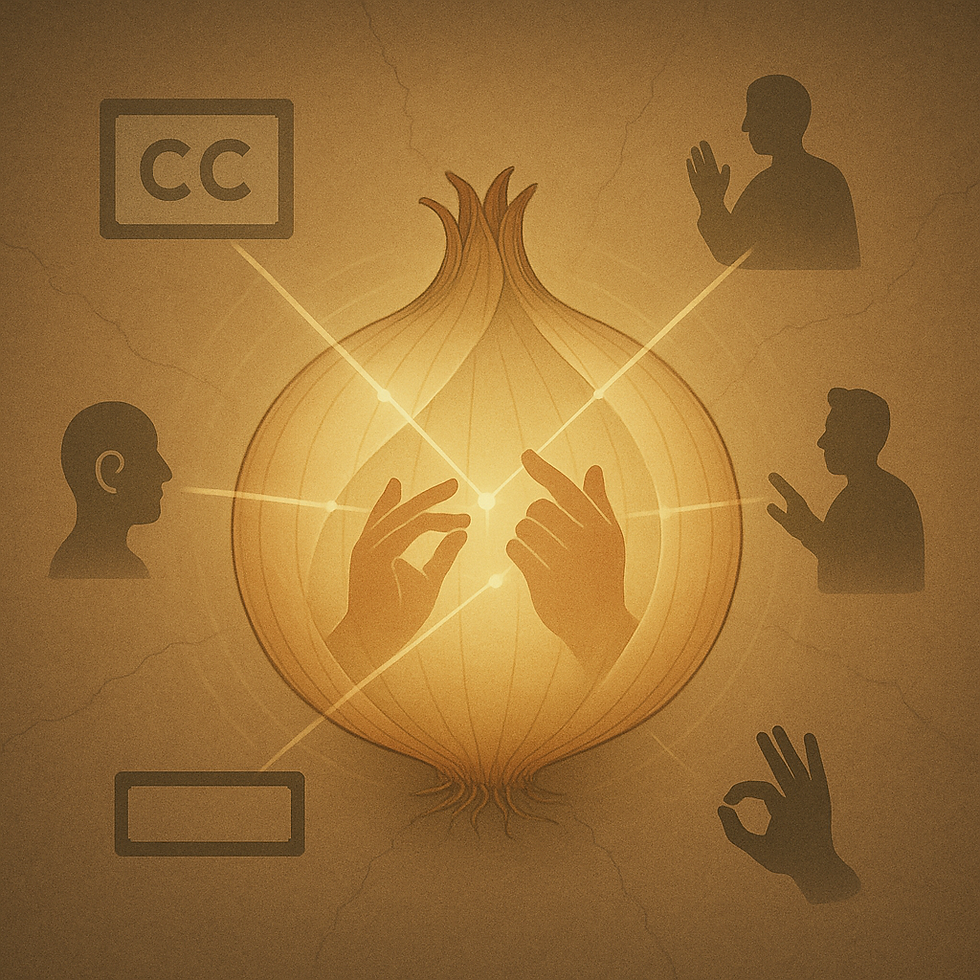
Once the thin skin of visibility is set aside, the first true layer we reach is access. For many people outside the Deaf community, this is where the conversation begins and often, where it ends. Access is what they see on the surface: captions glowing across the bottom of a screen, an interpreter standing beside a speaker, hearing aids or cochlear implants presented as “solutions,” or technology marketed as a bridge to the hearing world. These things matter deeply. They change lives, open doors, and make communication possible where it once was not. But just as an open door does not make a home, access alone does not make belonging.
Access is often mistaken for the destination, when in truth it is only the threshold. It is the space where language, technology, and understanding meet but not always in harmony. A caption can make words visible, yet when it lags, freezes, or mistranslates, meaning slips through the cracks. What reaches the viewer is not the same as what was said. An interpreter can carry language across boundaries, but interpretation is not duplication, it’s transformation. The interpreter’s decisions, timing, training, and presence shape every moment of communication, sometimes enriching the exchange, sometimes limiting it.
Technology, too, has its limits. A hearing aid or cochlear implant can amplify sound, but it cannot amplify culture. It cannot translate the emotional nuance of sign language or the unspoken rhythm of a Deaf conversation. It cannot teach hearing people to pause, to face the person signing, to let silence breathe. Access gives us tools but tools are only as powerful as the respect and awareness that guide their use.
For Deaf people who are also autistic, ADHD, or otherwise neurodivergent, this layer becomes even more intricate. Access points multiply: captions below, an interpreter to the side, a speaker at the front, a slide deck glowing with text. The eyes can only be in one place at a time, yet the world often expects them to be in three. Switching attention between these streams: hearing, seeing, reading, processing can be exhausting. Even when access looks complete on paper, the lived experience may tell a different story: mental fatigue, missed meaning, or the quiet ache of exclusion.
True access is not just about what is provided but how it feels. Does it create inclusion or merely visibility? Does it offer connection or demand constant effort? Access that drains energy instead of restoring it, that isolates instead of includes, cannot be considered full or fair.
To peel this layer of the onion is to see that access is not an act of charity or kindness. It is not a favor extended out of goodwill or a symbol of political correctness. Access is a right, a fundamental recognition of human dignity. And rights must be dependable, not occasional; systemic, not situational. They must exist not because it looks good to provide them, but because justice requires them.
True access does not end with a caption or a ramp or a device. It extends into the environment itself, the design of the classroom, the flow of conversation, the attitudes of those present. It is built when the Deaf person, the neurodivergent person, the whole person, can participate fully and authentically, without apology or compromise.
This layer of the onion teaches us something vital: bridges are not enough if they collapse underfoot. Access that exists in name but not in practice only reinforces distance. It’s not enough to offer the bridge, we must maintain it, strengthen it, and ensure it leads somewhere real.
When access is done well, it becomes invisible in the best possible way. It stops feeling like an extra step and starts feeling like part of the environment, like oxygen, necessary and assumed. That is the goal: not to make Deaf people adapt endlessly to hearing norms, but to create spaces where both can meet halfway, equally supported by thoughtful design and cultural respect.
Access, then, is not the end of our journey inward. It’s the first meaningful step beneath the surface, a layer that invites us to think not just about what is possible, but about what is equitable. It asks: Are we merely including people, or are we ensuring they can thrive?
The onion continues to peel, leading us deeper, from the mechanics of access to the heart of communication itself. In the next layer, we will explore how Deaf and neurodivergent styles of expression reshape the way we understand language, not just as words or signs, but as bridges between worlds, carrying emotion, rhythm, and thought.
Next week, we peel further inward into communication differences, how expression, pace, and perception redefine what it means to truly understand one another.
~ A. Bret Cummens, M.Ed.


Comments